Example 4.3 — Incorporating River Effects with AEM Linesink Drift
Script: docs/examples/ex_linesink_drift.py
Output: docs/examples/output/ex_linesink_drift.svg
Overview
This example demonstrates Universal Kriging with AEM (Analytic Element Method) linesink drift to model the hydraulic influence of rivers on groundwater levels. Rivers act as boundary conditions in groundwater systems — water levels near a gaining river are elevated relative to the regional trend, while levels near a losing river may be depressed. The AEM linesink drift term captures this spatial pattern as a deterministic component of the kriging model.
The example is fully self-contained: the synthetic river shapefile is created programmatically inside the script, so no external data files are required.
Setup
| Parameter | Value |
|---|---|
| Training points | 25 (synthetic, seed=42) |
| True field | Water levels influenced by AEM potential of RiverA + noise |
| Variogram model | Spherical |
| Sill | 2.0 |
| Range | 40 (same units as coordinates) |
| Nugget | 0.1 |
| Anisotropy | Enabled — angle=60° azimuth (CW from North, N60E direction), ratio=0.7 |
| Drift terms | linear_x, linear_y (polynomial) + RiverA, RiverB (AEM) |
| Prediction grid | 50 × 50 (2 500 nodes) |
| Coordinate domain | [0, 100] × [0, 100] |
River geometry
| Group | Segments | Resistance | Description |
|---|---|---|---|
RiverA |
2 (connected) | 1.0 | Main channel, east-west |
RiverB |
1 | 0.6 | Tributary, NW–SE |
config.json equivalent
{
  "data_sources": {
    "observation_wells": {
      "path": "path/to/wells.shp",
      "water_level_col": "wl_m"
    },
    "linesink_river": {
      "path": "path/to/river.shp",
      "group_column": "group",
      "strength_col": "resistance",
      "rescaling_method": "adaptive"
    }
  },
  "variogram": {
    "model": "spherical",
    "sill": 2.0,
    "range": 40,
    "nugget": 0.1,
    "anisotropy": {
      "enabled": true,
      "ratio": 0.7,
      "angle_major": 60
    }
  },
  "drift_terms": {
    "linear_x": true,
    "linear_y": true,
    "linesink_river": {
      "use": true,
      "apply_anisotropy": true
    }
  },
  "grid": {
    "x_min": 0, "x_max": 100,
    "y_min": 0, "y_max": 100,
    "resolution": 2
  }
}
How It Works
Step 1 — Create the synthetic river shapefile
The script builds a GeoDataFrame with three LineString geometries and writes
it to a temporary shapefile using geopandas. This mirrors exactly what the
production pipeline reads from data_sources.linesink_river.path.
river_segments = [
    {"geometry": LineString([(10, 60), (40, 55)]), "group": "RiverA", "resistance": 1.0},
    {"geometry": LineString([(40, 55), (80, 50)]), "group": "RiverA", "resistance": 1.0},
    {"geometry": LineString([(30, 80), (45, 60)]), "group": "RiverB", "resistance": 0.6},
]
river_gdf = gpd.GeoDataFrame(river_segments, crs="EPSG:32632")
river_gdf.to_file(river_shp_path)
Segments sharing the same group value are summed into a single drift column.
Here RiverA contributes one column (sum of its two segments) and RiverB
contributes a second column.
Step 2 — Coordinate transformation
Because anisotropy is enabled, all coordinates are transformed to model space before kriging:
transform_params = get_transform_params(x_obs, y_obs, angle_deg=60.0, ratio=0.7)
x_model, y_model = apply_transform(x_obs, y_obs, transform_params)
The transformation:
1. Translates to the data centroid
2. Converts azimuth 60° to arithmetic 30° internally (alpha = 90 - azimuth)
3. Rotates using the arithmetic angle so the major correlation axis
aligns with the X-axis in model space
4. Scales the Y-axis by 1/0.7 ≈ 1.43 to make the field isotropic
Angle convention:
angle_major=60°is an azimuth (clockwise from North), meaning the major axis of spatial correlation points in the N60E direction. This matches the KT3D SETROT convention. Internally converted to 30° arithmetic.
Step 3 — AEM drift matrix (training)
compute_linesink_drift_matrix() is called with
input_scaling_factors=None (training phase):
aem_matrix_train, aem_names, trained_scaling_factors = compute_linesink_drift_matrix(
    x_model, y_model,
    river_gdf,
    group_col="group",
    transform_params=transform_params,
    sill=SILL,
    strength_col="resistance",
    rescaling_method="adaptive",
    apply_anisotropy=True,
    input_scaling_factors=None   # training: compute factors from data
)
Because apply_anisotropy=True, the linesink segment endpoints are also
transformed to model space before the AEM potential is evaluated. This ensures
the river geometry is consistent with the anisotropically-transformed observation
coordinates.
The function returns:
- aem_matrix_train — shape (N_obs, N_groups), one column per river group
- aem_names — ['RiverA', 'RiverB']
- trained_scaling_factors — {'RiverA': 3.93e-02, 'RiverB': 1.77e-01}
Step 4 — Polynomial drift
Linear polynomial terms are computed in model space:
resc = compute_resc(SILL, x_model, y_model, RANGE)
poly_matrix_train, poly_names = compute_polynomial_drift(
    x_model, y_model,
    {"drift_terms": {"linear_x": True, "linear_y": True}},
    resc
)
resc normalises the polynomial columns to be numerically comparable to the
variogram sill, preventing ill-conditioning of the kriging matrix.
Step 5 — Combined drift matrix
The polynomial and AEM columns are concatenated horizontally:
combined_matrix_train = np.hstack([poly_matrix_train, aem_matrix_train])
# shape: (25, 4)  →  columns: [linear_x, linear_y, RiverA, RiverB]
The column order is the term_names contract: [linear_x, linear_y, RiverA, RiverB].
This order must be reproduced identically at prediction time.
Step 6 — Build UK model
uk_model = build_uk_model(x_model, y_model, z_obs, combined_matrix_train, vario)
build_uk_model() passes the drift columns to PyKrige as
drift_terms=["specified"] with specified_drift containing each column as a
1-D array. PyKrige solves the Universal Kriging system and stores the drift
coefficients internally.
Step 7 — Grid prediction (reusing scaling factors)
At prediction time, the same trained_scaling_factors must be passed back
to compute_linesink_drift_matrix():
aem_grid, _, _ = compute_linesink_drift_matrix(
    gx_model, gy_model,
    river_gdf,
    group_col="group",
    transform_params=transform_params,
    sill=SILL,
    strength_col="resistance",
    rescaling_method="adaptive",
    apply_anisotropy=True,
    input_scaling_factors=trained_scaling_factors   # <- critical
)
If input_scaling_factors is omitted, the function recomputes scaling from the
grid points' potential values, which will differ from the training-phase scaling.
The drift coefficients solved during training would then be applied to
differently-scaled columns, producing incorrect predictions.
The AEM Potential
The potential at a point (x, y) due to a single linesink segment from
(x1, y1) to (x2, y2) with strength σ and length L is:
φ = (σ · L / 4π) · Re[(ZZ+1)ln(ZZ+1) − (ZZ−1)ln(ZZ−1) + 2ln(L_vec/2) − 2]
where ZZ = (z − mid) / half_L_vec maps the physical plane to the normalised
segment coordinate [-1, 1], and z = x + iy is the complex coordinate.
The potential is highest near the segment and decays with distance. Multiple segments in the same group are summed before scaling.
Scaling Factor Persistence
| Phase | input_scaling_factors |
Behaviour |
|---|---|---|
| Training | None |
Factors computed as sill / max(|φ|) for each group |
| Prediction | trained_scaling_factors |
Stored factors reused exactly |
| Prediction (wrong) | None |
New factors computed from grid — incorrect |
The adaptive scaling formula is:
rescr = sill / max(|φ|)
This normalises each group's potential so its maximum value equals the variogram sill, making the AEM drift columns numerically comparable to the polynomial drift columns and to the variogram covariance values.
Output Figure
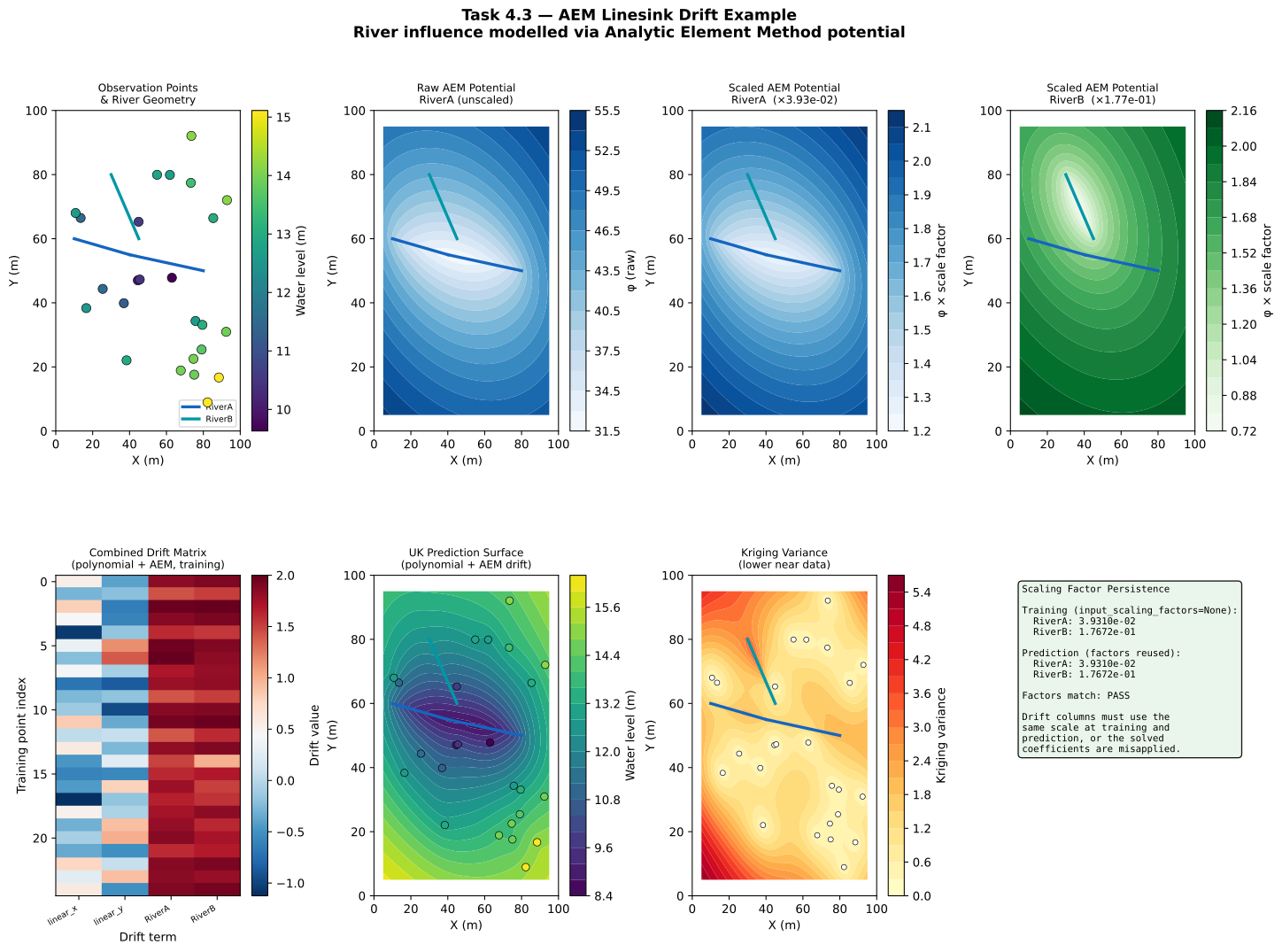
The SVG figure contains eight panels:
| Panel | Content |
|---|---|
| Top-left | Observation points coloured by water level, with river geometry |
| Top-centre-left | Raw (unscaled) AEM potential field for RiverA |
| Top-centre-right | Scaled AEM potential field for RiverA (after × 3.93e-02) |
| Top-right | Scaled AEM potential field for RiverB (after × 1.77e-01) |
| Bottom-left | Combined drift matrix heatmap (all 4 columns, all 25 training points) |
| Bottom-centre-left | UK prediction surface with observation points and river overlay |
| Bottom-centre-right | Kriging variance (lower near data, higher in gaps) |
| Bottom-right | Scaling factor persistence explanation and verification result |
Key Takeaways
-
River geometry is self-contained — the shapefile is created by the script; no external data files are needed.
-
apply_anisotropy=Truemeans the linesink segment endpoints are transformed to model space before AEM potential evaluation. This keeps the river geometry consistent with the anisotropically-transformed observation coordinates. -
Scaling factors are a training artifact — they must be stored after training and passed to every subsequent prediction call via
input_scaling_factors. The script verifies this explicitly and printsPASSwhen the factors match. -
Column order is a contract — the combined drift matrix always follows
[linear_x, linear_y, <AEM groups in group_col order>]. Changing this order between training and prediction will corrupt the kriging solution. -
Adaptive vs fixed rescaling —
rescaling_method='adaptive'(default) normalises each group's potential to the variogram sill.'fixed'uses the KT3D constantsill / 0.0001, which can produce very large drift values in metric coordinate systems.
See Also
docs/theory/aem-linesink.md— AEM theory and the complex potential formuladocs/api/aem_drift.md— Full API reference forcompute_linesink_drift_matrix()docs/examples/ex_linear_drift.md— Polynomial drift example (simpler starting point)docs/examples/ex_anisotropy.md— Anisotropy handling example