Task 4.4 — EXAMPLE: Anisotropy Handling
Script: docs/examples/ex_anisotropy.py
Output: docs/examples/output/ex_anisotropy.svg
Overview
This example demonstrates how UK_SSPA v2 handles geometric anisotropy — directional dependence of spatial correlation — using the coordinate pre-transformation approach.
Scenario:
- 20 synthetic observation points with true anisotropic spatial correlation generated via Cholesky decomposition of an anisotropic spherical covariance matrix
- angle_major=30 deg (azimuth, N30E direction), ratio=0.3
- Major correlation along the direction perpendicular to angle_major
- Minor correlation along the angle_major direction (N30E)
Critical: How angle_major Relates to the Correlation Axes
The
angle_majorparameter specifies the direction that gets STRETCHED in model space, which corresponds to the direction of SHORTER correlation (the minor axis). The major correlation axis is PERPENDICULAR toangle_major.
This is because apply_transform() works as follows:
1. Convert azimuth to arithmetic internally (alpha = 90 - azimuth)
2. Rotate using coords @ R — this maps the angle_major direction to the Y-axis
3. Scale Y by 1/ratio — this stretches Y-axis distances, making them larger in model space
4. Larger model-space distances → variogram reaches its range sooner → shorter effective correlation
Numerical verification (from the script output):
NE (1,1) -> model dist=4.714 (stretched by 1/ratio=3.3)
NW (-1,1) -> model dist=1.414 (unchanged)
Ratio of distances: 3.33 (= 1/ratio)
For angle_major=30 deg (azimuth, N30E), ratio=0.3, range=120:
| Direction | Maps to in model space | Scaling | Effective range in raw space | Role |
|---|---|---|---|---|
N30E (30° azimuth = angle_major) |
Y-axis | Stretched by 1/ratio = 3.3 | 120 * 0.3 = 36 | Minor axis |
| Perpendicular (120° azimuth) | X-axis | Unchanged | 120 | Major axis |
Angle Convention
All angles in UK_SSPA v2 are azimuth — measured clockwise from the positive Y-axis (North). This matches the KT3D SETROT convention.
angle_major (azimuth) |
Direction stretched | Major correlation direction |
|---|---|---|
| 0° | North (+Y) | East/West (perpendicular) |
| 30° | N30E | Perpendicular to N30E |
| 45° | NE | NW/SE (perpendicular) |
| 90° | East (+X) | North/South (perpendicular) |
Conversion to/from arithmetic (internal):
arithmetic = 90 - azimuth   (mod 360)
azimuth    = 90 - arithmetic (mod 360)
Synthetic Data Generation
The example generates data with true anisotropic spatial correlation using the same transform as the production code:
- Place 20 random points in a 200x200 domain
- Transform coordinates to model space using
apply_transform()with the sameangle_majorandratio - Compute pairwise distances in model space (where the field is isotropic)
- Build a spherical covariance matrix using
range_majorin model space - Generate correlated values via Cholesky decomposition:
z = L @ N(0,1)whereL L^T = C
This ensures the synthetic data has the exact anisotropic structure that the kriging model expects.
Anisotropy Parameters
ANGLE_MAJOR = 30.0   # degrees azimuth (CW from North) — N30E direction
RATIO       = 0.3    # minor_range / major_range
RANGE_MAJOR = 120.0  # range in model space = effective range along perpendicular direction
- Major range = 120 units along the direction perpendicular to N30E
- Minor range = 120 * 0.3 = 36 units along N30E (
angle_majordirection)
Pre-Transformation Steps
Given raw coordinates X = (x, y):
Step 1 — Translate to centroid:
X_c = X - center
Step 2 — Convert azimuth to arithmetic (internal):
alpha = 90 - angle_major = 90 - 30 = 60°
Step 3 — Rotate using coords @ R:
X_r = (X_c) @ R

R = [[cos(α), -sin(α)],
     [sin(α),  cos(α)]]
angle_major direction maps to the Y-axis and the perpendicular direction maps to the X-axis.
Step 4 — Scale Y by 1/ratio:
X' = S * X_r, S = [1.0, 1/ratio]
angle_major direction) is stretched, making the field isotropic in model space.
Full formula: X' = S * ((X - center) @ R)
Why Clone the Variogram with anisotropy_enabled=False?
After pre-transforming the coordinates, the field is already isotropic in model space. If PyKrige's internal anisotropy were also enabled, the transformation would be applied twice.
# Clone with anisotropy disabled — passed to PyKrige
vario_iso_clone = vario_aniso.clone()
vario_iso_clone.anisotropy_enabled = False
vario_iso_clone.anisotropy_ratio = 1.0
vario_iso_clone.angle_major = 0.0

# Build model in model space
uk_model = build_uk_model(x_model, y_model, z,
                          drift_matrix=None, variogram=vario_iso_clone)
Contract:
build_uk_model()checksanisotropy_enabled. WhenFalse, it setsanisotropy_scaling=1.0andanisotropy_angle=0.0in PyKrige.
Prediction Pipeline
# 1. Compute transform parameters from training data
params = get_transform_params(x_raw, y_raw, angle_deg=30.0, ratio=0.3)

# 2. Transform training coordinates to model space
x_model, y_model = apply_transform(x_raw, y_raw, params)

# 3. Build model in model space (clone with anisotropy_enabled=False)
uk_model = build_uk_model(x_model, y_model, z,
                          drift_matrix=None, variogram=vario_iso_clone)

# 4. Transform prediction grid to model space (same params!)
flat_x_model, flat_y_model = apply_transform(flat_x, flat_y, params)

# 5. Predict in model space
z_pred, variance = uk_model.execute("points", flat_x_model, flat_y_model)
Output Figure
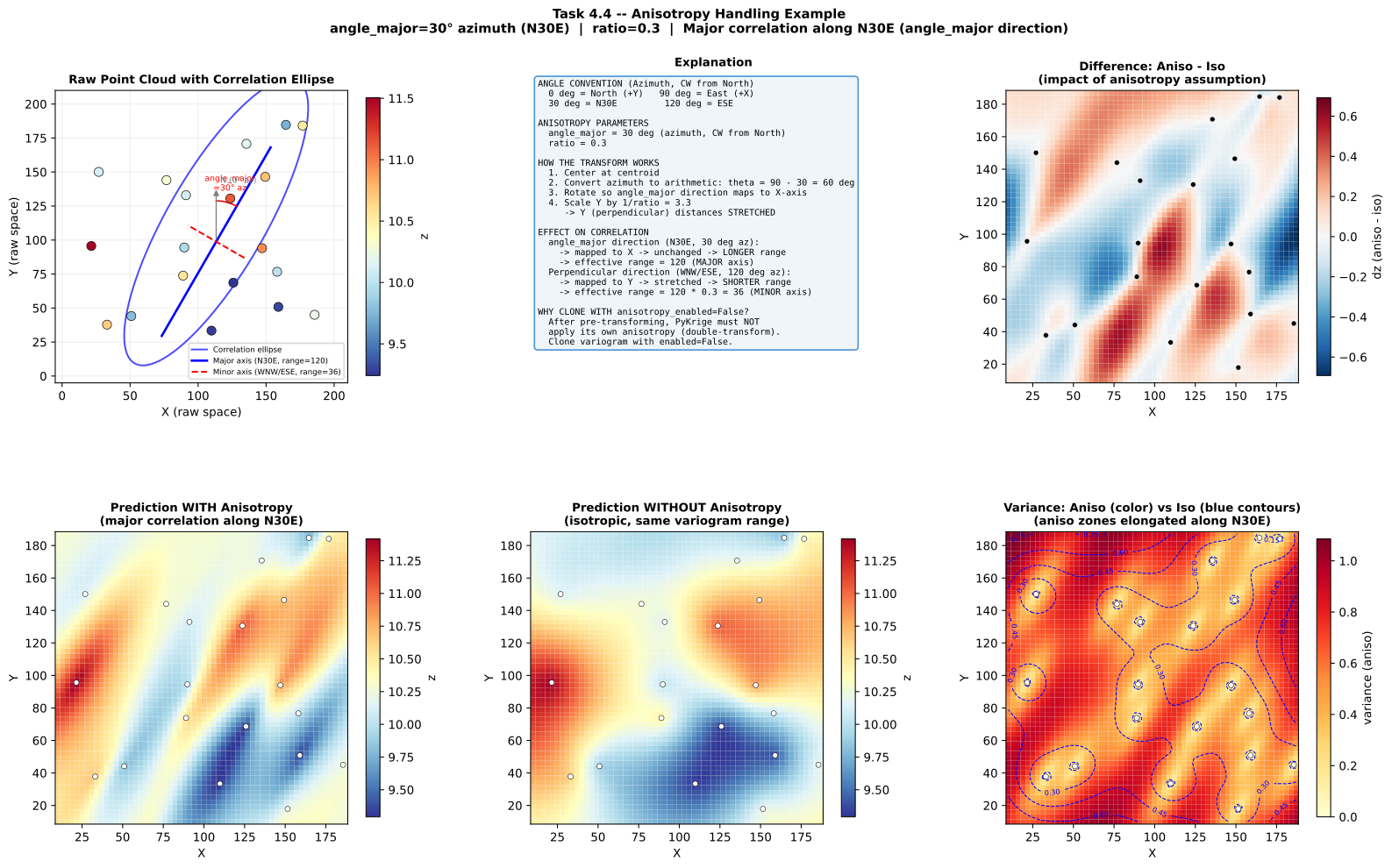
The 6-panel figure shows:
| Panel | Description |
|---|---|
| Top-left | Raw point cloud with correlation ellipse: major axis perpendicular to N30E (blue, range=120), minor axis along N30E (red dashed, range=36), angle arc showing angle_major=30° azimuth |
| Top-center | Explanation panel: transform mechanics, how angle_major maps to the minor axis |
| Top-right | Difference map (aniso minus iso) showing where anisotropy changes the prediction |
| Bottom-left | Prediction with anisotropy — correlation elongated perpendicular to N30E |
| Bottom-center | Prediction without anisotropy — treats all directions equally |
| Bottom-right | Variance comparison: aniso variance (color) vs iso variance (blue contours) — aniso low-variance zones elongated perpendicular to N30E |
Key observations: - The prediction with anisotropy shows smoother interpolation along the major correlation axis (perpendicular to N30E), correctly reflecting the directional structure - The variance panel shows elongated low-variance zones along the major correlation direction around observation points - The isotropic prediction treats all directions equally, producing circular influence zones
Verification
Roundtrip error: 4.26e-14  (< 1e-12 threshold)
NE (1,1) -> model dist=4.714 (stretched by 1/ratio=3.3)
NW (-1,1) -> model dist=1.414 (unchanged)
Key Takeaways
-
angle_majorspecifies the direction that gets stretched (the minor correlation axis). The major correlation axis is perpendicular to it. -
For
angle_major=30°(azimuth, N30E): N30E gets stretched (minor, range=36), the perpendicular direction is unchanged (major, range=120). -
Pre-transformation converts raw coordinates to model space where the field is isotropic, then isotropic kriging is applied.
-
Clone the variogram with
anisotropy_enabled=Falsebefore passing tobuild_uk_model()to prevent double-application. -
Both training and prediction must use the same
transform_paramscomputed from training data. -
The
ratio = minor_range / major_range, soratio=0.3means the minor range is 30% of the major range.